 (832) 275-8051
(832) 275-8051
(832) 275-8051
Tell us what is wrong with your vehicle. Corey can help with common mobile mechanic repairs at your home, office, or roadside.
Trusted Certifications & Affiliations











Give me a call or send me a text — I'll come to you, wherever you are.
Need citywide help? Visit our mobile mechanic Houston page for same-day service details.
Most of the time, we take our vehicles for granted because of how advanced they are. However, it is essential to know the warning signs of a problem and when to get the vehicle checked. Knowing how the brakes work can also help you determine when it’s time to get them replaced. Here at AQM we have all the resources and expertise needed to diagnose any issues you may be experiencing with your brakes. Give us a call today to learn more.
Typically, manufacturers install hydraulics into a vehicle to help the brakes function properly. Therefore, when the pedal is pressed, a plunger is released in the master cylinder which moves the pressurized fluid. The fluid’s pressure increases through the brake lines and compresses each wheel’s cylinder. Vehicles made earlier used to use a set of cables and pulleys to receive the pressure from your pedals to the wheels. Therefore, mechanical lines needed much more maintenance and precision. The issue with brake wires is that they could snap at the worst times or send the cylinders different pressures.
In the 1950s, the use of hydraulics became common in the production of cars for their safety and durability. However, brakes themselves serve as a form of kinetic energy that transfers into the wheels and creates friction.
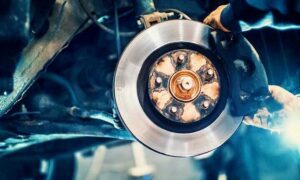
Therefore, there are two types of brakes that ensures no metal-on-metal friction. The first are drum brakes which are attached to the wheel in order to brake properly. However, the most common option manufacturers use is disc brakes because they don’t heat up as easily as drum brakes. These types of brakes increase the surface area that applies the friction. They are open to air, cool off faster, and reduce heat overall.
It is not normal for your brakes to just fail all of a sudden. Typically, you will discover issues with your brakes through clear warning signs. Therefore, manufacturers have installed indicators so that when they are beginning to wear they will make noise. It is not only essential at saving you and your passengers but more importantly ensuring the car is functioning to the best of its abilities.
Usually, your brake light is the first indication that you need maintenance on your brakes. This light can indicate that it is time for an inspection. Here at AQM we check your entire brake system for issues. Furthermore, ensure that your parking brake isn’t activated and be the cause of the indicator. Here are a few signs that it is time for a brake maintenance or replacement.
Another common indication that it may be time for new brakes, is the noise that they make. These sounds may include rattling, screeching, squealing, and much more. Therefore, if you are experiencing a loud metallic squealing noise, this means that your brakes have been worn down. As stated before, the brake pads have steel indicators. However, when they are in direct contact with your rotors they will emit a squealing noise.
Another common noise or issue is grinding which can be the result of numerous issues. Therefore, if you feel grinding, there may be a rock or some type of gravel that is stuck in the caliper. Additionally, issues can stem from lack of lubrication on the rear drum brakes. If you have went a long time without receiving routine maintenance on your brakes, then your brake pads can be in jeopardy of your brakes wearing sooner than later. Ensuring that you take care of these issues when they first arise can save you the headache and money.
If your vehicle begins vibrating when you apply the brakes, then it most likely means that you have an uneven rotor. The rotors that fit inside the wheel need to be proportionate in order to use the right pressure overall. Therefore, it has to be exact to thousandths of an inch. With normal wear and tear, they will begin to develop slight variations. Therefore, when you get you receive maintenance on your brakes, your rotors should be trued as well.
Furthermore, there may be a possibility that your brake caliper is not working properly. This is what squeezes your brake pads to the rotor and slows you down. The piston inside the caliper causes it to squeeze down and apply friction. As time progresses, the heat and road debris can lead to the piston sticking. This means that the caliper will not go back to the full off position once you remove pressure from the brake.
If you notice that your brakes are slower and softer than usual, then this can be an indication that your brakes may be leaking fluids. If you are experiencing issues such as these, contact professionals like us to help you solve the problem. Although you may be aware of where your brake fluid reservoir is, it could be leaking from the master cylinder or anywhere in the braking system.
Your brakes should never go all the way to the floor. With automatic brakes, your pedal should stop at least an inch above the floor of your vehicle. When it comes to manual vehicles, they should be at least three inches from the floor. If your pedal feels soft, spongy, or it sinks when they are applied, this can be an indication that that air or moisture is in the braking system.
If you realize your is leaning to one side every time you apply the brakes, it means that each brake is receiving uneven pressure. This can be an indication that either there are issues with the calipers or something wrong with the brake hose. Regardless, it can be very dangerous to drive your vehicle with the braking system being unevenly pressured.
Our team of mechanics are on-call and ready to help you. We provide our services 7 days a week from 5 AM to 7 PM! Additionally, our services are extended to all of Houston and its surrounding areas. We work on just about any make or model except for trucks and tractors. If you are looking for emergency brake service, give us a call at (832)-275-8051 today!
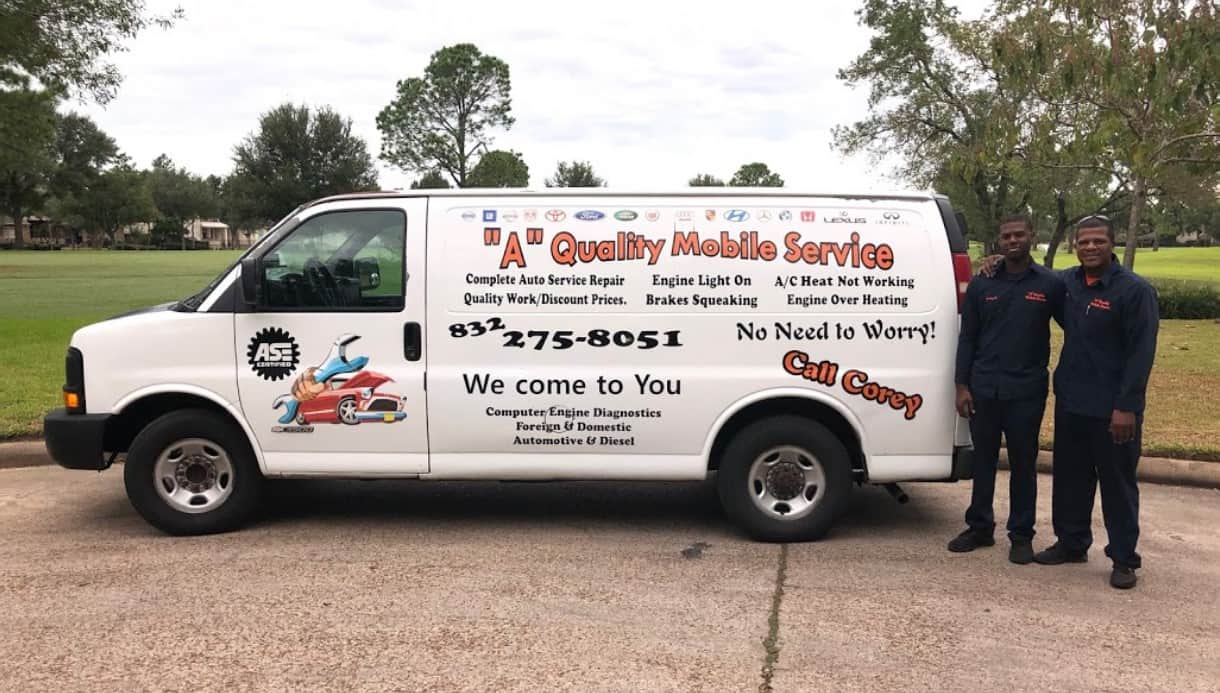
Your Local Houston Mechanic
A Quality Mobile Service is a locally owned and operated mobile mechanic business serving Houston and the surrounding areas. Our certified technicians come to you — saving you time, money, and the hassle of a traditional shop.
We are available 7 days a week, 5 AM to 7 PM, across the entire Houston metro.
Auto repair should not be a hassle! When you are in a bind, A Quality Mobile Service mechanics will come to you.
What We Fix
From a dead battery to complex engine work — our certified mechanics handle it all at your location.



All of our mechanics are ASE certified and carry the training, knowledge, and tools to get your vehicle repaired right — the first time. Shop-quality service at your driveway.
Service Coverage
Stuck at home, at work, or on the side of the road? We cover the entire Houston metro.
Don't see your city? Call us at (832) 275-8051 — we likely cover it.
Why Choose Us
No waiting rooms. No tow trucks. No hassle.
Every technician holds ASE certification — the gold standard in automotive repair.
We fix your car at your home, office, or wherever you're stranded. No tow needed.
Need it fixed fast? We offer same-day appointments across Houston and surrounding areas.
No shop overhead means lower prices. We beat shop rates without cutting corners.
Customer Reviews
Hundreds of Houston drivers trust A Quality Mobile Service to keep them on the road.
We ran out of gas on the side of the road and they came out to us within the hour.
Thank you for your very professional and prompt response.
They helped us transport our flooded car. I called around and A Quality had the best price in town.
Get A Repair Estimate
Fill out the form and we'll get back to you fast. Or skip the wait and call us directly.
Same-day response • No obligation • ASE Certified mechanics
Fastest response — call us directly:
(832) 275-8051Error: Contact form not found.
Your information is private and never shared.